
She Wasn't Supposed to Teach Me That
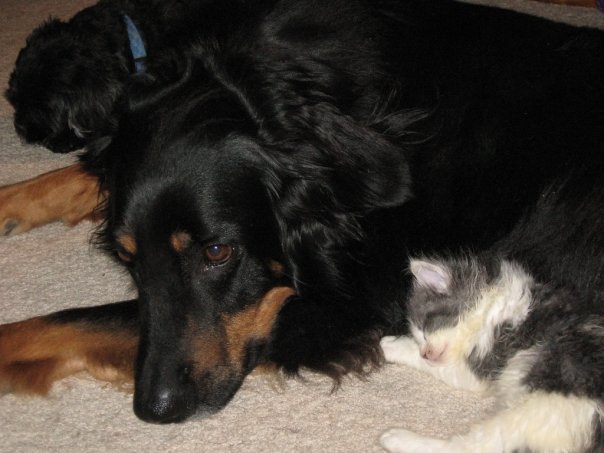
Her name was Frey-ja. A Hovawart — my first dog as an adult. I flew to Seattle to bring her home at eight weeks old, and from the beginning she was everything: hiking buddy, running partner, the dog I planned to train for search and rescue.
At two years old, she was diagnosed with hip dysplasia.
Search and rescue was no longer her path. But as I would eventually understand, her path was something far more important.
I began learning everything I could — swimming to reduce the compound stress on her joints, acupressure, and eventually massage therapy. I earned my certification through Boulder College of Massage Therapy and started working with her regularly. I watched her move more freely. I watched her settle more deeply. I watched her body respond to intentional, consistent touch in ways that humbled me.
Then one day, I tried something different. I brought Reiki into our session.
I still remember the moment it shifted. She relaxed more fully than I had ever seen her relax. Something transformed — in her, and in me. She seemed more grateful. More present. More at ease in a body that had caused her pain for years.
Frey-ja taught me that the body and the energy field are not separate things. She taught me to listen. And she taught me that healing is not something we do to an animal — it is something we do with them, when they trust us enough to receive it.
That lesson has shaped everything I do.
When Massage and Reiki Meet
Frey-ja showed me something I now offer every animal I work with: the combination of massage and Reiki addresses both the physical body and the energetic body simultaneously.
Massage releases what the muscles are holding. Reiki addresses what the nervous system and energy field are holding. Together, they create a depth of relaxation and restoration that neither achieves alone.
Not every animal is ready for both at once — and I never impose. I follow the animal's lead entirely. But when they're ready, when trust has been established and the body begins to soften, the integration of these two modalities is something I've witnessed transform animals again and again.
Frey-ja groaned in pleasure during our sessions as she aged. A dog who had every reason to brace herself against pain when touched, chose instead to lean in.
That is what massage can do. That is what listening makes possible.
A Note on Experience
My certification in canine massage therapy was earned through Boulder College of Massage Therapy — a rigorous, hands-on program that has since closed its doors. My 20+ years as a Registered Veterinary Technician informs every session: I understand anatomy, physiology, pathology, and the medical picture behind what I'm feeling under my hands.
But the deepest education came from Frey-ja.
She lived a full, active, joyful life — 12 years, 10 of them carrying a hip dysplasia diagnosis as an 80-pound dog. She ran trails and climbed mountains and groaned with pleasure on the massage table well into her senior years. She is the reason I do this work.
If your dog deserves even a fraction of what she taught me, I would be honored to work and learn beside them.
What Massage Actually Does
Think of canine massage the way you think of massage and stretching for yourself.
When your muscles are tight, your body compensates. Other muscles pick up the slack, working harder than they should, creating new tension, new imbalance, new discomfort. Over time, what started as one problem quietly becomes several.
Massage interrupts that cycle.
For mobility and muscle support: Therapeutic massage loosens tight, overworked muscles and helps restore the body's natural movement patterns. For dogs with hip dysplasia, arthritis, or other joint conditions, this can mean the difference between a dog who moves reluctantly and a dog who moves with confidence and less pain.
For the lymphatic system and immune health: Massage stimulates lymphatic circulation — the body's internal drainage system. When lymph flows well, the immune system works more efficiently. I also use massage therapeutically for dogs experiencing edema, helping move fluid and reduce swelling in a gentle, non-invasive way.
For phantom pain: This one surprises people. Dogs who have lost a limb or a tail — for whatever reason — can experience phantom pain, just as humans do. Massage addresses the nervous system pathways involved and can bring real, meaningful relief to animals carrying an invisible burden.
For the nervous system: Touch regulates. A dog who is anxious, reactive, or chronically stressed carries that tension in their body. Intentional, compassionate massage helps the nervous system downshift — not as a trick, but as a genuine physiological response to safe, skilled touch.
For aging animals: Senior dogs often carry years of compensation patterns, old injuries, and the quiet aches of a life fully lived. Regular massage supports their comfort, their mobility, and their quality of life in ways that are simple, natural, and deeply effective.
Sessions & Pricing
Therapeutic Massage — 45 minutes · $75
Gentle, consent-based massage tailored to your pet’s comfort. May include light fascia work, stretching, or acupressure-inspired touch. Includes a follow-up email with session notes and care suggestions.
Holistic Massage + Reiki — 45 minutes · $120
A session blending therapeutic massage and Reiki, tailored to your animal’s comfort. Includes a follow-up email with notes and recommendations.
Complimentary Healy frequency support may be included when available. A $20 out-of-area surcharge applies to in-home visits.
Request a session with Janette Fetter →
What to Expect in a Session
Sessions are consent-based and conducted entirely at your animal's pace. Your dog can move, reposition, or opt out at any time — and I honor that without hesitation. I use a quiet setup, gentle and intentional techniques, and I pay close attention to what your animal's body is telling me throughout.
Sessions typically run 45 minutes.
I will pause or modify a session for:
Fever or acute injury
New or unexplained lameness
Contagious illness
Any condition requiring veterinary clearance first
Post-surgical timing is always coordinated with your veterinarian.